
Ghana and Nuclear Energy: The Gap Between Promise and Readiness

Every few years, Ghana reaffirms its commitment to nuclear energy. The intentions and targets are clear. The timelines are always ambitious. And then, almost without notice, the targets shift. The original target of nuclear power by 2030 has already been revised to the mid-2030s. Yet the national conversation still tends to ask the wrong question: should Ghana go nuclear? The more important question, and the one most Ghanaians are not asking, is whether Ghana has what it takes to turn a six-decade ambition into reality.
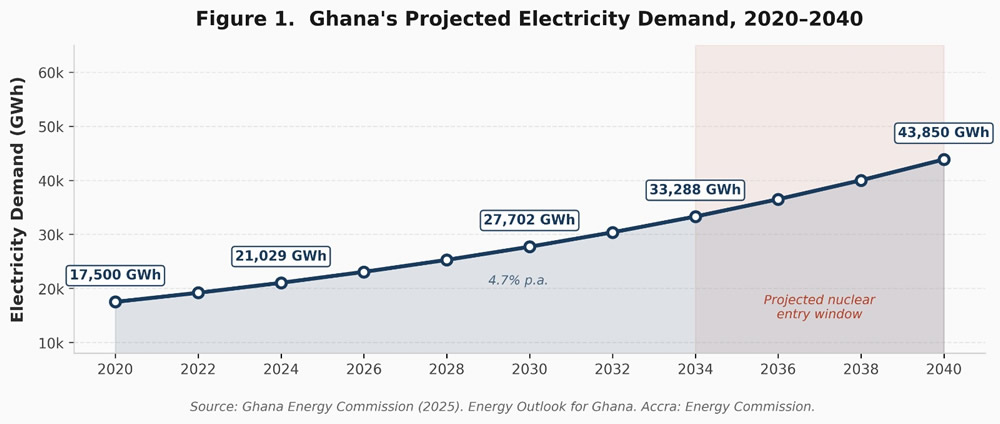
Understanding why nuclear energy is being seriously considered requires looking at where Ghana’s energy sector is headed. Electricity demand is growing at 4.7% annually, and projections from the Ghana Energy Commission indicate demand will more than triple by 2040, from 17,500 GWh in 2020 to 55,000 GWh. Our grid leans heavily on thermal generation, which accounts for 69% of installed capacity and is exposed to global fuel price shocks.
Hydropower, once our backbone, is increasingly unreliable due to rainfall variability. Renewable energy is expanding rapidly and offers some of the most affordable options for electricity generation. However, as its share grows, its variable generation profiles require complementary investments in grid management, flexible generation, and storage to ensure a consistent and reliable electricity supply.
Nuclear energy can play an important role in this mix, providing a stable, low-carbon, high-capacity power source that supports system reliability while advancing Ghana’s climate commitments under the Paris Agreement.
Progress on Ghana’s nuclear programme, while incremental, is real and worth acknowledging. In September 2012, the Ghana Nuclear Power Programme Organisation (GNPPO) was established as the country’s Nuclear Energy Programme Implementing Organisation (NEPIO), tasked with coordinating activities across all stakeholder institutions and serving as Ghana’s primary interface with the International Atomic Energy Agency (IAEA). Building on this foundation, Nuclear Power Ghana (NPG) was subsequently created as the national owner-operator entity, mandated to lead site evaluation, engage prospective international vendors, and ultimately commission and manage Ghana’s first nuclear power plant.
Supporting these implementing bodies is an independent regulatory framework anchored by the Nuclear Regulatory Authority (NRA), established under Act 895 in 2015 and operational since January 2016. The NRA’s independence is reinforced by Ghana’s ratification of key international nuclear instruments, including the Convention on Nuclear Safety and the Joint Convention on the Safety of Spent Fuel Management and on the Safety of Radioactive Waste Management.
In December 2024, the NRA completed its first International Regulatory Review Service (IRRS) mission, a rigorous peer assessment conducted by the IAEA to evaluate the robustness and independence of the country’s nuclear regulatory framework, a milestone that significantly strengthens Ghana’s regulatory credibility in the eyes of both investors and international partners.
Together, these institutions delivered two significant milestones: IAEA Phase 2 status in August 2022, the formal recognition that preparatory work is genuinely underway, and the endorsement of the primary site at Nsuban in the Western Region by an IAEA evaluation mission in February 2025. These achievements place Ghana among the better-prepared newcomer nuclear countries on the continent.
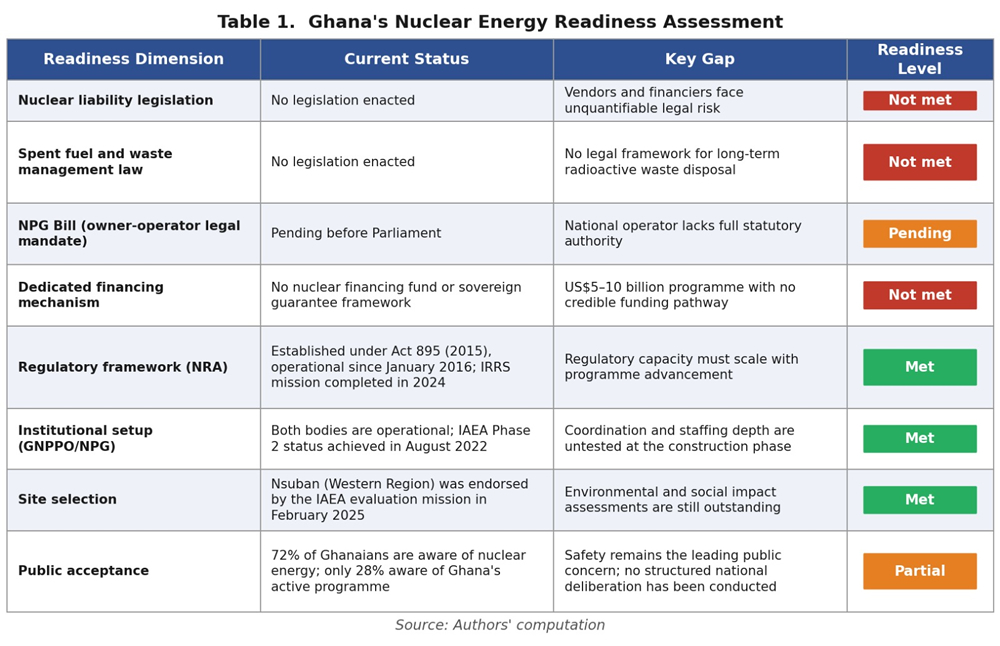
However, critical gaps remain that cut to the heart of the viability. Of Ghana’s nuclear programme. The most urgent is legislative. Ghana is yet to enact a nuclear liability legislation, meaning vendors and international financiers face an undefined and unquantifiable legal liability risk, and a limited pool of financing institutions will commit capital to a programme where liability in the event of an accident is legally undefined. Compounding this, there is no spent fuel and waste management law, and the NPG Bill establishing the legal framework for the national operator is still pending in Parliament. Without this legislative foundation, the resulting financing gap becomes almost impossible to bridge.
Further, Ghana has no dedicated nuclear financing stream, and the government has not established a sovereign guarantee framework for an investment that could cost between $5 and $10 billion. This creates a significant financing gap that could delay or constrain project development. Sitting underneath this is a public acceptance problem that risks destabilising the entire effort. Survey data show that while 72% of Ghanaians are aware of nuclear energy as a concept, only 28% know that Ghana has an active programme, and safety remains the number one public concern. Without resolving that deficit of trust and awareness, even a well-financed and legally sound programme will struggle to sustain the political will it needs to survive successive administrations and reach completion.
These gaps, however, do not close the window of opportunity. If anything, that window has widened in recent years. The World Bank and IFC shifted policy in June 2024 to allow nuclear project financing for the first time in decades, creating a concessional funding pathway that simply did not exist for previous generations of Ghanaian policymakers. Ghana’s Phase 2 status and endorsed site selection mean the country enters that new financing environment with credible credentials. The technology landscape has also shifted in Ghana’s favour.
Traditional large-scale reactors, typically around 1,200 megawatts, would represent a substantial addition to Ghana’s grid in a single unit, creating concentration risks and integration challenges that the IAEA cautions against for newcomer countries. By contrast, Small Modular Reactors (SMRs), generating between 50 and 300 megawatts per module, enable incremental grid integration and require lower upfront capital. For a country of Ghana’s grid size and fiscal constraints, this modular approach is not just an alternative worth considering; it is arguably the more practical and scalable pathway to introducing nuclear power.
Table 1. Ghana’s Nuclear Energy Readiness Assessment
Table 1 below presents a systematic assessment of Ghana’s readiness across the key dimensions required for a credible nuclear power programme, highlighting areas of progress and critical gaps that remain unresolved.
Translating this opportunity into reality means confronting the gaps directly rather than managing them through announcement. This will require action on four fronts:
1. Close the Legal and Regulatory Gaps
Parliament must pass the nuclear liability, waste management, and NPG Bills without further delay. Until these are in place, discussions on financing and vendor contracts remain fundamentally constrained.
2. Establish a Credible Financing Strategy
Ghana should pursue a blended financing approach that combines the newly available World Bank and IFC concessional pathways with export credit agency support and public-private partnership structures. This will help reduce sovereign exposure and avoid the debt dependencies that have complicated nuclear projects elsewhere on the continent.
3. Adopt Small Modular Reactors as the Entry Pathway
Ghana should take a clear position and adopt Small Modular Reactors as its entry pathway into nuclear power, aligning technology choice with the country’s grid realities and fiscal constraints.
4. Deepen Public Engagement
Public engagement must move beyond awareness campaigns into genuine national deliberation, giving Ghanaians a meaningful voice in a decision whose consequences will extend well beyond the current generation of leadership.
Ghana has built institutions, trained personnel, engaged the world, and earned a credible place in the global nuclear conversation. But credibility is not capacity, and interest is not readiness. The gap between what Ghana has declared and what Ghana has built is exactly where this programme will succeed or fail. Closing that gap, not reaffirming the ambition, is the work that now needs to be done.
By Dr. Eric Agyemang
Policy Analyst, IPPG